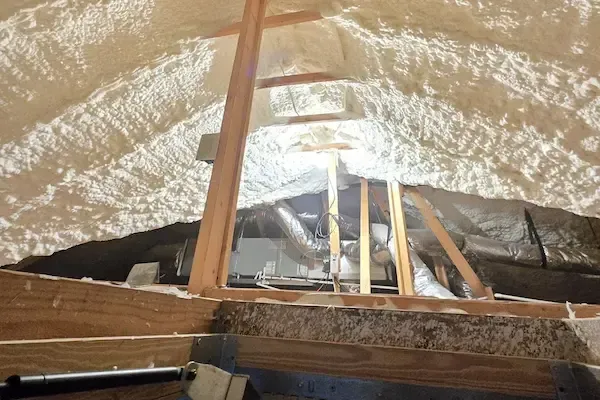
Why Does Attic Insulation Matter So Much?
Your attic doesn't just store holiday decorations and forgotten boxes. It's ground zero for the biggest energy battle your home fights every single day. Attic spray foam insulation transforms that 140°F oven above your ceiling into a protective barrier that actually keeps Texas heat where it belongs (hint: not in your living room).
At PCC Spray Foam, we've tackled hundreds of attic insulation projects across Fort Worth, Weatherford, Willow Park, and the surrounding areas, watching homeowners' jaws drop when their first post-installation energy bill arrives. After 8+ years of professional installations, we know exactly what makes attic spray foam insulation in Texas the smartest investment you'll make in home comfort and energy savings.
Why Traditional Attic Insulation Fails in Texas Heat—and What Actually Works
Think of your attic as the lid on a pot of boiling water. Without proper attic insulation, all that expensive conditioned air you're paying for rises straight up and escapes through your roof deck while brutal Texas heat radiates down into your living space.
Heat transfer through inadequately insulated attics accounts for 25-40% of total cooling costs in North Texas homes. Your air conditioner runs constantly, trying to compensate, never quite winning the battle against physics and poor insulation.
Traditional materials like fiberglass batts or blown-in cellulose provide some resistance, but they can't stop the air leaks that let your money float away.
Spray foam creates a complete thermal barrier that both insulates and seals simultaneously, delivering performance that cheaper alternatives simply cannot match.
What R-Value Do Texas Attics Really Need?
Building codes aren't just bureaucratic busy work. They actually reflect real-world thermal performance requirements based on climate data. Texas attic insulation R-value requirements specify R-30 to R-49, depending on your heating system and geographic location within the state.
Most North Texas homes need R-38 minimum to meet current energy code standards. Spray foam attic insulation achieves these values efficiently because closed-cell foam delivers R-6 to R-7 per inch while open-cell foam provides R-3.5 to R-3.8 per inch.
That means you need just 6-7 inches of closed-cell or 10-11 inches of open-cell to hit R-38. Compare that to fiberglass requiring 12-14 inches of fluffy material that compresses over time and loses effectiveness when it inevitably gets dusty or slightly damp.
How Much Does Spray Foam Attic Cost?
Let's talk money because spray foam attic cost matters when you're making investment decisions.
Open-cell spray foam runs approximately $0.90-$1.25 per board foot, while closed-cell costs $2.50-$3.25 per board foot installed. For a typical 1,500 square foot attic needing 10 inches of open-cell foam (15,000 board feet), you're looking at $13,500-$18,750.
Closed-cell at 6 inches (9,000 board feet) costs $22,500-$29,250. Yes, that's significantly more than the $2,000-$4,000 for blown-in alternatives. But here's what nobody tells you about cheap insulation: it doesn't stop air infiltration, settles over time, loses R-value, and needs replacement every 15-20 years.
Spray foam lasts 30+ years, delivers 30-40% energy savings immediately, and pays for itself within 5-7 years through reduced utility bills alone.
Should You Choose Open-cell or Closed-cell?
How to decide between open-cell and closed-cell foam for your home insulation? This question trips up homeowners constantly because both spray foam types work brilliantly in attics, just with different strengths.
Open-cell spray foam offers excellent thermal insulation at a lower cost, expands dramatically to fill every crack, and provides outstanding soundproofing benefits. It's perfect for attics in homes without serious moisture concerns.
Closed-cell foam brings premium moisture resistance, a higher R-value per inch, meaning less thickness needed, and adds genuine structural reinforcement to roof decks. Choose a closed-cell if your attic has moisture issues, you need maximum insulation in a limited space, or you want that extra layer of storm protection.
Most homeowners in Weatherford and surrounding areas do great with open-cell, while those with specific moisture or space constraints prefer closed-cell's superior capabilities.
What About Ventilation After Spray Foam?
Traditional attic insulation requires ventilation because those materials can't stop moisture from reaching the roof deck, creating perfect conditions for mold and wood rot. Spray foam changes everything by creating a sealed, conditioned attic space.
When you install spray foam insulation directly to the underside of your roof deck, you eliminate ventilation needs because moisture can't reach areas where it causes problems. This "unvented attic" approach actually works better in Texas because you're not pulling 100°F+ air through your attic space all day.
Your HVAC equipment stays cooler, ductwork operates more efficiently, and you gain usable storage space that isn't hot enough to melt chocolate. Building codes specifically allow unvented attics with spray foam insulation, and every major building science organization recommends this approach for hot climates.
Will Spray Foam Really Reduce Cooling Bills?
Numbers don't lie, and attic spray foam insulation delivers measurable results that show up immediately. Homes with properly installed spray foam attic insulation see average cooling cost reductions of 30-40% during brutal Texas summers.
That $400 July electric bill drops to $240-280 thanks to the thermal barrier preventing heat gain. Your air conditioner runs shorter cycles because it's not fighting constant heat infiltration from above. Over a decade, those savings add up to $15,000-$20,000 in avoided energy costs.
The best attic insulation for hot climates isn't the cheapest option upfront. It's the solution that stops paying utility companies for air that immediately escapes while delivering comfort that actually feels comfortable when you walk through your home at 3 PM on an August afternoon.
Expert Attic Spray Foam Installation In Fort Worth, Weatherford, Willow Park, And The Surrounding Areas
Attic spray foam insulation demands professional installation because mistakes cost money and performance.
At PCC Spray Foam, we bring certified technicians, proper equipment, and 8+ years of experience to every project in Fort Worth, Weatherford, Willow Park, and the surrounding areas. Our bilingual team (Se habla español) provides free consultations assessing your specific attic conditions, explaining options clearly, and delivering transparent pricing without hidden fees.
Contact us today at (682) 239-6710 to schedule your assessment and discover why smart Texas homeowners choose spray foam insulation for attics that finally stop costing money and start saving it.
FREQUENTLY ASKED QUESTIONS
What is the best attic insulation for Texas heat?
Spray foam insulation provides superior performance in hot climates by creating an air-sealed thermal barrier that blocks radiant heat transfer. Both open-cell and closed-cell spray foam dramatically outperform traditional materials in Texas conditions.
How much does it cost to spray foam a 1500 sq ft attic?
Open-cell spray foam costs approximately $13,500-$18,750, while closed-cell runs $22,500-$29,250 for a 1,500 square foot attic. The investment typically pays for itself within 5-7 years through energy savings of 30-40%.
What R-value does my Texas attic need?
Most North Texas attics require R-30 to R-38 minimum per building codes, though R-49 is recommended for maximum energy efficiency. Spray foam achieves these values with less thickness than traditional insulation materials.
Can you spray foam over existing attic insulation?
While technically possible, we recommend removing old insulation first for optimal results. This allows proper surface preparation, ensures complete coverage, and eliminates potential moisture or pest issues hidden beneath existing materials.
Will spray foam stop my attic from getting hot?
Spray foam applied to the roof deck creates a sealed, conditioned attic space that stays much cooler than traditional vented attics. Expect temperature reductions of 20-30°F compared to improperly insulated attics in summer heat.
Articles you might be interested in
Closed Cell Spray Foam Installation for Basements and Exterior Walls in Texas Homes
Open-Cell Spray Foam Benefits for Interior Walls and Soundproofing Your Home
Choosing the Best Insulation for Your Texas Home Based on Climate and Building Type
Spray Foam Insulation Cost in Texas: Complete 2026 Price Guide
How To Decide Between Open-cell And Closed-cell Foam For Your Home Insulation
